

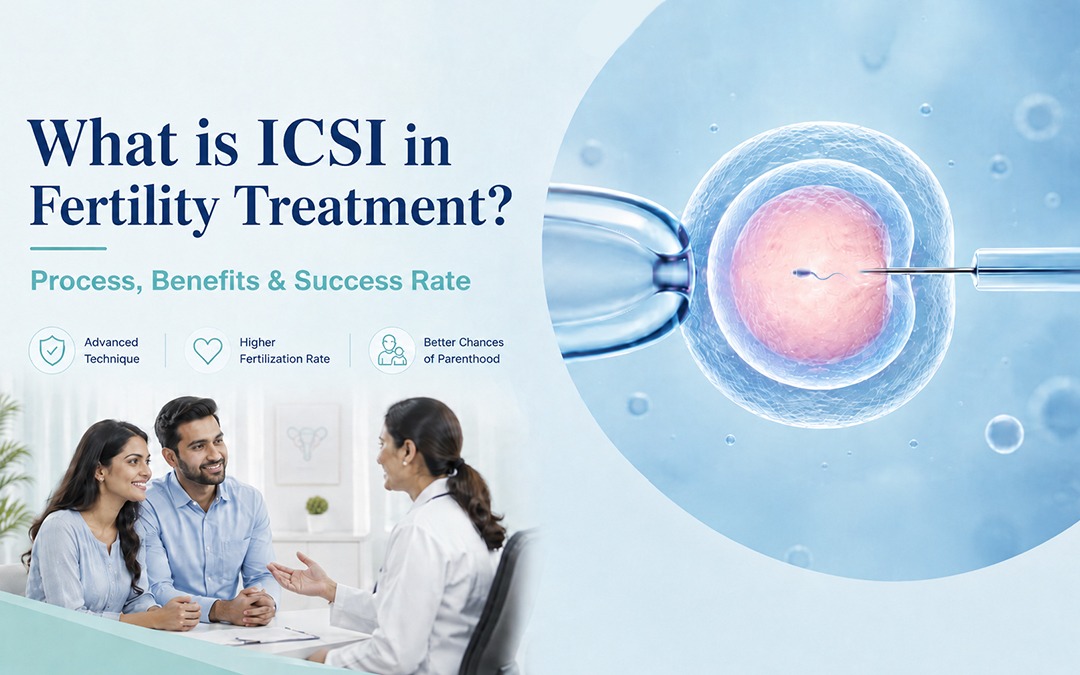
The parenthood journey can at times take an unexpected turn. As a result, many couples are compelled to explore the world of Assisted Reproductive Technology (ART).
Intracytoplasmic Sperm Injection procedure, better known as ICSI, is among the most important advancements in reproductive medicine.
You will likely come across the phase ICSI in Fertility Treatment if you’re navigating fertility struggles. This can especially be for those connected to male factor fertility.
ICSI In Fertility Treatment
Knowing how standard In-Vitro Fertilization (IVF) works will help in understanding ICSI.
Tens of thousands of swimming sperm in traditional ICSI are placed in a laboratory alongside a mature egg. The sperm to achieve fertilization must compete, bind to the egg’s outer layer (the Zona Pellucida) and naturally penetrate it.
This is taken by IVF with ICSI treatment a step further. Highly skilled embryologists use specialized microscopic tools instead of leaving fertilization to chance. The tools are used to select a single, healthy-looking sperm. Later, the sperm is injected directly into the center (mytoplasm) of a mature egg.
‘Cosmetic’ by itself implies a purely aesthetic goal. Many of these treatments address physical discomfort, like urinary incontinence caused by pelvic floor laxity or irritation from enlarged labia. The dual focus on form and function is the reason why it’s referred to as ‘Vaginal Rejuvenation Treatment’ by many medical practitioners.
What does ICSI stand for?
- I: Intra inside.
- C: Cytoplasmic-the cytoplasm (the gel-like substance inside the egg cell).
- SI: Sperm Injection-the deliberate introduction of sperm.
ICSI, by bypassing the need for the sperm to swim to the egg and break through its outer shell, eliminates several major barriers to fertilization. It does not replace IVF. ICSI is a specialized enhancement that’s executed during an IVF cycle.
ICSI VS IVF Difference: What Distinguishes Them?
In-Vitro Fertilization (IVF) and ICSI are two common terms. They are often used interchangeably. However, they represent distinct laboratory methods.
The ICSI VS IVF difference predominantly concerns how fertilization happens inside the laboratory.
| Feature | Traditional IVF | IVF with ICSI |
|---|---|---|
| Sperm Introduction | Sperm & Eggs are mixed together in a dish; sperm penetrates naturally | Single sperm is picked up and injected directly into the egg. |
| Sperm Count Required | Requires a high concentration of motile (swimming) sperm (thousands per egg) | Requires only one viable sperm per retrieved egg. |
| Primary Indication | Female factor infertility; unexplained infertility; & tubal blockages | Male factor infertility; Previous fertilization failure; & Thick egg shells. |
| Embryologist Intervention | Moderate (monitoring & preparing samples) | High (requires micro-injection precision tools). |
Every other part of the treatment for both procedures remains exactly the same. This includes ovarian simulation, egg retrieval, and embryo transfer.
Who requires ICSI treatment?
A common query often asked is – Who needs ICSI treatment?
ICSI was originally developed to treat severe male infertility issues. Its application has since expanded. Reproductive Endocrinologists evaluate a couple’s complete fertility profile before suggesting this path.
Male Infertility Treatment Options
The following male infertility treatment options are highly effective to address:
- Severe Oligozoospermia: Extremely low sperm count. They are lesser than 5 million sperm per milliliter.
- Extremely low sperm count. They are lesser than 5 million sperm per milliliter. Poor sperm motility. This prevents the sperm from effectively reaching or penetrating the egg.
- Teratozoospermia Abnormal sperm morphology (shape). The sperm is prevented from binding effectively to the egg shell.
- Azoospermia Sperm is totally absent in the ejaculate. They can often be retrieved directly from the testicles or epididymis. This is done using surgical extraction techniques. Techniques like TESA (Testicular Sperm Aspiration) or PESA (Percutaneous Epididymis Sperm Aspiration).
Fertility Treatments for Low Sperm Count & Quality
Standard IVF carries a high risk of ‘total fertilization failure’ when a semen analysis discloses low numbers or poor quality. ‘Total Fertilization Failure’ indicates zero eggs get fertilized.
ICSI, on the other hand functions as an insurance policy against this specific hurdle. It makes it the definitive choice among fertility treatments for low sperm count.
Other Indications for ICSI
Doctors may also suggest ICSI for reasons that are unrelated to sperm health.
Like,
- Previous IVF Failure: Indicates if a couple underwent traditional IVF previously and had poor or zero fertilization despite normal sperm parameters.
- Frozen Oocytes (EGGS): Cryopreservation (freezing) can at times burden an egg’s outer shell. Once the egg is thawed, ICSI helps to ensure the hardened barrier can be bypassed by the sperm.
- Preimplantation Genetic Testing (PGT):Embryos are being tested for genetic abnormalities. ICSI herein is preferred. They prevent extra, non-fertilizing sperm from sticking to the eggs outer area and contaminating the genetic test outcomes.
The ICSI Treatment Procedure – Step by Step
An assisted reproduction cycle involves physical preparation, medical procedures, and precise laboratory work.
The following details ICSI treatment procedure step by step. This will help you precisely understand what to expect.
Step 1: Ovarian Stimulation
Fertility medications (hormonal injections) are taken by the female partner for roughly 8 to 12 days.
They stimulate the ovaries to grow multiple fluid-filled sacs called follicles. Each contains an egg instead of the single egg usually produced every month. Progress is monitored closely via Transvaginal Ultrasounds and blood tests.
Step 2: The Trigger Shot
A trigger shot of Human Chorionic Gonadotropin (hCG) or a GnRH agonist is administered once the follicles reach an optimal size. This is usually 18-20 mm.
This injection kick-starts the final maturation process of the eggs.
Step 3: Egg Retrieval
The intracytoplasmic sperm injection procedure officially starts exactly 34 to 36 hours after the trigger shot. They start their clinical phase with egg retrieval.
The procedure is executed under light sedation. This will allow the patent to not feel any pain. An ultrasound-guided needle is inserted through the vaginal wall gently by the specialist to aspirate the follicular fluid containing the mature eggs.
Step 4: Sperm Collection and Processing
The male partner provides on the same day as the egg retrieval a semen sample. In case surgical sperm retrieval (like YESA) is needed, it is scheduled to coincide with this window.
The semen sample is washed by the laboratory. This is done to separate the healthiest, highest quality sperm from the seminal fluid and debris.
Step 5: Micro Injection (The ICSI Technique)
Specialized laboratory work takes place here.
- Retrieved eggs are treated with an enzyme to remove surrounding cells. This will allow the embryologist to confirm which eggs are mature. Only mature eggs can be used for ICSI.
- Embryologist using a gentle suction pipette (holding pipette) secures a mature egg in place.
- The embryologist then uses a fine, hollow glass needle to immobilize a single, morphologically normal sperm. This is done by gently touching its tail.
- Sperm is drawn tail-first into the needle.
- The needle is carefully inserted through the outer shell into the center of the egg. There, the sperm is gently released.
Step 6: Incubation and Monitoring
The injected eggs are placed into a specialized incubator. This incubator mimics the natural environment of the human fallopian tubes. Later, over the next 16 to 18 hours, the checking of signs of successful fertilization (appearance of two nuclei) starts.
Finally, the fertilized eggs divide and grow over the next 3 to 5 days into embryos.
Step 7: Embryo Transfer
On reaching the cleavage stage (Day 3) or blastocyst stage (Day 5) for the transfer, one or more healthy embryos are selected.
Then, a thin, flexible catheter is passed by a doctor through the cervix to place the embryo direct into the uterus. For future use, the rest of high-quality embryos, if any, can be frozen.
Major Benefits of ICSI Treatment
It is important to know before weighing your options the distinct benefits of ICSI treatment.
Overcomes Severe Male Infertility: Offers a realistic biological path to parenthood for men with extremely low sperm counts, poor movement, or structural abnormalities,
This helps those who otherwise could not conceive naturally or via standard IVF.
- Maximizes Limited Samples:ICSI maximizes for men who have frozen a limited amount of sperm prior to cancer treatments, or those needing surgical sperm extraction, the utility of every single cell.
- High Fertilization Rates: ICSI yields a predictable fertilization rate per mature egg as it removes the physical barriers to entry. This reduces the anxiety of a total fertilization failure in the lab.
- Enables Advanced Screening:ICSI facilitates the clean use of PGT. This allows couples with known hereditary genetic conditions to screen embryos without implantation, sans the risk of parental DNA contamination from the stray sperm.
ICSI Success Rates: What the Numbers Say?
The question on everyone’s mind when evaluating any fertility option often is – ‘What are the odds of taking home a baby?’
Fertilization Success Vs Pregnancy Success
There is a necessity to separate fertilization rates from live birth rates.
Fertilization rate with ICSI is quite high. Typically, between 70 percent and 80 percent of mature eggs injected will fertilize successfully.
A fertilized egg, at the same time, must still develop into a high-class embryo. It also needs to implant successfully into the uterine lining and grow throughout a full-term pregnancy.
ICSI Success Rate by Age
The single most critical factor influencing the final pregnancy outcome just like traditional IVF, is the age of the female partner, as the quality of the egg naturally declines over time.
The following details ICSI success rate by age:
- Under 35 Years:Highest rates of success. They often range for every birth rate per embryo transfer 45 percent to 55 percent.
-
35 to 37 Years: Success rates hover around 35 percent to 40 percent. - 38 to 40 Years:Success rates generally drop. They drop to 20 percent to 30 percent.
- Above 40 Years:Success rates are typically under 10 percent to 15 percent. They often prompt discussions about the use of donor eggs if multiple cycles are successful.
Male sperm quality matters for initial fertilization. However, female partner’s age remains the major driver for long-term implantation and live birth outcomes.
ICSI Success Rate in India
The ICSI success rate in India aligns closely with global benchmarks. This is heavily supported by state-of-the-art laboratories and globally trained embryologists.
Young couples facing pure male-factor infertility can in top-tier fertility clinics across India look forward to clinical pregnancy success rates per fresh embryo transfer cycle of 50 percent or higher.
This high-grade success, paired with affordability, drives India’s growing reputation as a global hub for medical tourism in reproductive health.
ICSI Fertility Treatment Cost in India
Proper financial planning is critical to investment in fertility treatment.
The ICSI Fertility Treatment cost in India differs from place to place. This is based on geography, clinic infrastructure, expert experience of the medical team, and individual patient needs.
A single standard IVF cycle in India on average costs between Rs 1,500,000 and Rs 2,500,000. That’s because ICSI involves highly advanced micromanipulation equipment, specialized dishes, and intensive labor by a senior embryologist.
Finally, clinics in India usually charge on top of the base IVF cost, an additional fee.
Estimated Cost Breakdown
- Base IVF Package:Includes ovarian monitoring, egg retrieval, laboratory fees, and embryo transfer.
- ICSI Premium Charges:Adds to the base cost an additional Rs 30,000 to Rs 50,000.
- Total Estimated Investment:Determines the complete cycle of IVF with ICSI. They generally range from Rs 1, 80,000 to Rs 3, 00,000 per cycle.
Variable Factors That Can Increase Total Costs
- Advanced Sperm Retrieval Techniques:Procedures like PESA, TESA, or Micro-TESE for zero sperm count. They add surgical and anesthesia fees (this can approximately be RS 20,000 TO Rs 50,000).
- Preimplantation Genetic Testing (PGT):If you’re selecting screen embryos for chromosomal abnormalities, then they can add Rs 15,000 to Rs 25,000 for every embryo tested.
- Embryo Freezing (Cryopreservation):Storing extra embryos for future use comes with an additional freezing cost and an annual maintenance fee. They can approximately be Rs 20,000 to Rs 40,000 per year.
- Medication Volume:Women who need higher dosages of gonadotropin injections due to low ovarian reserve will likely face higher pharmacy bills.
Final Word
Fertility challenges can be, at times, daunting. There are, thankfully, tools today like ICSI in Fertility Treatment. They have profoundly reshaped the landscape of reproductive medicine.
ICSI by providing a clear solution for low sperm counts, poor motility; and previous fertilization obstacles, offers an accurate and reliable pathway to building your family.
Schedule a comprehensive evaluation. This includes a detailed semen analysis for him and an ovarian reserve check for her. They are the right starting point if you’re trying to conceive without success.
You can save time, emotional stress, and financial resources by discussing if an intracytoplasmic sperm injection procedure is suitable for your unique situation or not. It can put you on the road to parenthood.