

Parenthood journey for the majority of couples and individuals is not always a smooth process.
Irregular or absent ovulation is often among the most common bottlenecks in conception. Thankfully, modern reproductive medicine has come as a blessing in disguise. They offer a foundational, non-invasive starting point - Ovulation Induction.
What is Ovulation Induction?
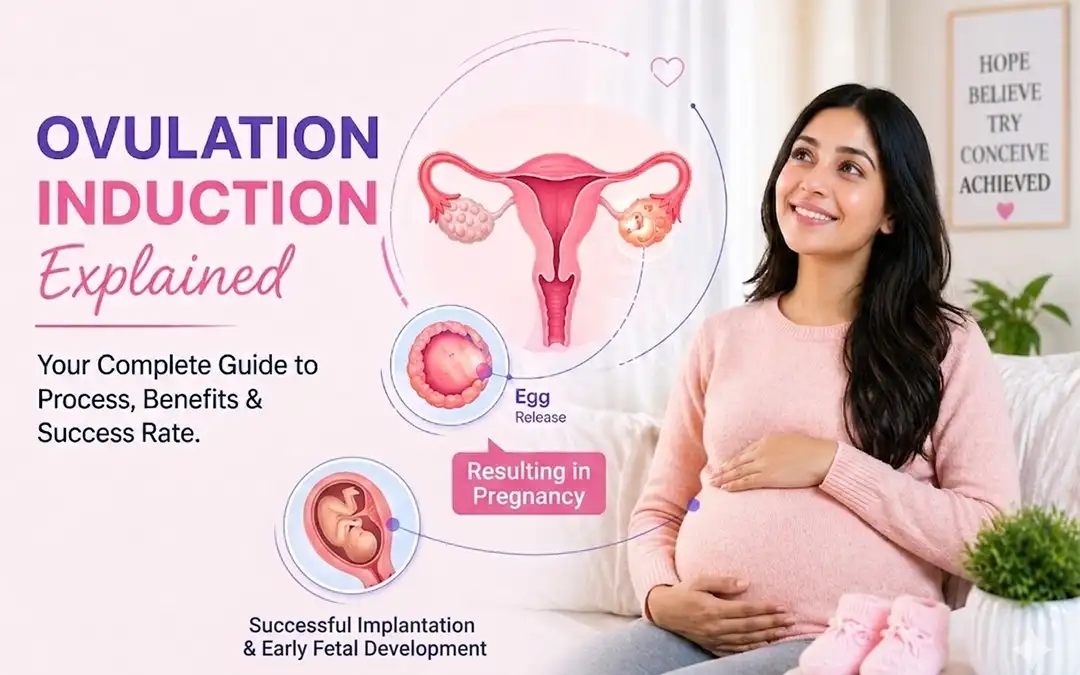
In fertility treatments, Ovulation Induction leverages hormonal medications to stimulate the ovaries. This helps create and release eggs.
The body naturally releases one egg per cycle. However certain conditions can disrupt the cycle rhythm.
This treatment is majorly a fertility treatment for ovulation problems.
They are designed to treat women who
- ‘Jumpstart’ the reproductive cycle.They are not able to ovulate regularly (anovulation), or
- Ovulate. But have inconsistent cycles (oligo-ovulation).
By regulating the hormonal environment, the goal is to increase the chances of conception through timed intercourse or artificial insemination.
Who is a Candidate?
Women who experience:
- Hormonal imbalances. Like thyroid disorders or pituitary issues.
- Polycystic Ovary Syndrome (PCOS).
- Unexplained infertility.
- Irregular menstrual cycles.
Types of Ovulation Induction
The treatment approach varies. They vary based on the underlying cause of infertility.
Medication used categorically determines the types of Ovulation Induction.
Like,
- Oral Medication: Drugs like Clomiphene Citrate or Letrozole are frequently used. They trick the brain into producing more Follicle-Stimulating Hormone (FSH). This helps to drive the growth of follicles.
- Injectable Medications (Gonadotropins): Contains FSH or a mixture of FSH and Luteinizing Hormone (LH) that work on the ovaries directly. They are used if oral medications are not successful.
- Metformin: Is primarily an insulin sensitizing medication. It’s often used for patients with PCOS helping normalize their ovulation patterns.
How the Ovulation Induction Procedure Works?
It’s critical to understand ‘How Ovulation Induction procedure works.’
This involves understanding the step-by-step management of a woman’s cycle.
The ovulation induction procedure is a highly monitored process. This helps ensure safety and also maximize the ‘fertile window.’.
Steps in Ovulation Induction Treatment
- Step 1- Assessment & Baseline: Cycle starts usually on day 2 or 3 of the period with an ultrasound and blood tests. This ensures the ovaries are quiet, ready for stimulation.
- Step 2- Stimulation: Patient starts to take for a set number of days the prescribed medication.
- Step 3- Monitoring: Termed as the critical phase. Patient undergoes transvaginal ultrasound and blood work. This helps track the growth of ovarian follicles (the sacs containing the eggs).
- Step 4- The Trigger Shot: ‘Trigger shot’ of Human Chorionic Gonadotropin (hCG) starts, once the follicles reach an optimal size. This is administered to induce the egg’s final maturation and release.
- Step 5- Conception: Ovulation occurs typically 24 to 36 hours after the trigger shot. The specialist during this time will advise timed intercourse. Else will perform an Intrauterine Insemination (IUI).
Benefits of an Ovulation Induction
The benefits of Ovulation Induction for many extend beyond an egg’s physiological release.
- Non-Invasive: Is unlike surgical intervention primarily a medication-based approach.
- Cost-Effective: ignificantly more affordable. This is when compared to advanced procedures like IVF.
- Corrects Irregularity: Provides a predictable cycle. This reduces the stress of not knowing when (or if) is ovulating taking place.
- Enhanced Monitoring:Helps early identification of any other prospective reproductive issues. All through the process, specialists track the cycle.
Ovulation Induction Success Rate
The ovulation induction success rate is a primary issue when considering any treatment.
The success rate per cycle on average ranges from 10 percent to 20 percent. This depends on the patient’s age and the underlying cause of infertility.
Ovulation Induction Success Rate by Age
In fertility outcomes, age remains the most significant factor.
- Under 35: Success rates are at their peak. They often mirror natural conception rates of healthy couples.
- 35-39: Success remains steady. But they can require more cycles. Else they will need to switch to Gonadotropins.
- 40 & Above: Success rates decline rapidly. Egg quality and quantity will naturally decrease.
Is Ovulation Induction Safe?
Often it’s asked – Is Ovulation Induction safe?
The answer is ‘YES.’
It has been used for decades with a high safety profile.
However, there remain two major risks:
- Multiple Gestations: Stimulating the ovaries can drive the release of more than one egg. This increases the chances of having twins or triplets.
- Ovarian Hyperstimulation Syndrome (OHSS): Rare condition. It involves ovaries overreacting to the medication. This can however be prevented through frequent monitoring designed specifically for this purpose.
How it differs from other treatments?
It’s often asked by patients as how Ovulation Induction for infertility stands in comparison to more complex procedures.
The following gives an idea on the same.
- Ovulation Induction Vs IUI: Ovulation induction focuses more on egg production. IUI (Intrauterine Insemination) on the other hand, places more emphasis on sperm delivery. They are often used together. The sperm in an IUI cycle is washed and directly placed during the induced ovulation window into the uterus.
- Ovulation Induction Vs IVF: Ovulation Induction seeks fertilization inside the body. IVF (In-Vitro Fertilization) on the other hand retrieves eggs from the ovaries. Then, fertilizes them with sperm in a laboratory. Later they transfer the embryo back to the uterus.
Final Word
Ovulation Induction remains in the arsenal of reproductive health as a powerful tool.
It offers a high degree of hope with a structured, monitored path to egg release. This benefits those struggling with hormonal or cycle-related infertility.
If you have been trying to conceive sans success or been experiencing irregular periods, then it’s time to consult a specialist. The Ovulation Induction procedure treatment could be the first step toward building your family.