

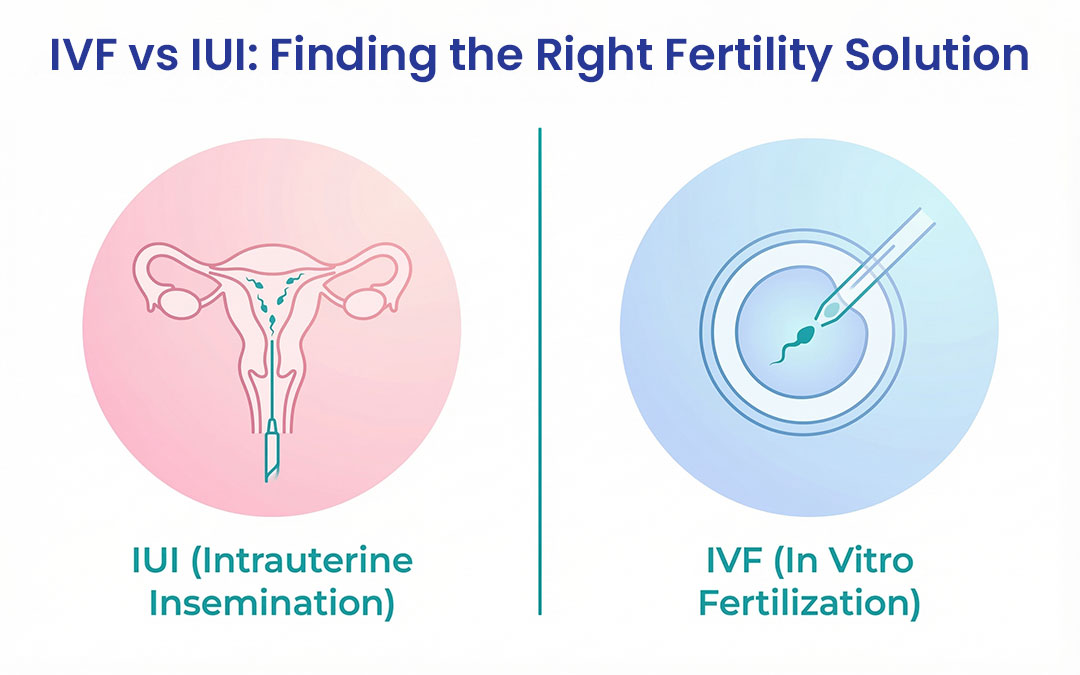
Making a choice between IUI (Intrauterine Insemination) and IVF (In-Vitro Fertilization) is among the most significant decisions in your fertility journey.
The landscape of reproductive medicine in 2026 has gravitated toward Precision Fertility.
In Precision-Fertility, AI-driven analytics and non-invasive testing are making these choices much clearer and more successful than ever.
Which Makes For A Better Choice: IVF Vs IUI?
The following details the difference between IVF and IUI, and which among the two makes for the better choice.
Fundamental Difference: Location Of Conception
The main difference between the two is where the outcome happens.
Is it inside the body or in a specialized laboratory?
The following details the same :
IUI (The Assisted Natural Path): Termed as a headstart for sperm, it involves:
- Doctor placing during ovulation high-quality, washed sperm directly into the uterus.
- Fertilization still occurs naturally inside the fallopian tubes.
IVF (The Lab-Directed Path): A more intensive process, it involves
- Eggs surgically retrieved from the ovaries.
- Eggs fertilized with sperm in a laboratory.
- Embryo growth for several days before being transferred into the uterus.
Evolution Of The IUI Journey
The Intrauterine Insemination (IUI) journey is simple, fast, and low-invasive.
For many, it is often the first port of call as it mimics the natural process with a clinical boost.
The process takes about 2-4 weeks.
- Ovulation Induction : Oral medications like Letrozole or Clomid. They help facilitate the growth of 1-2 healthy follicles.
- Monitoring : Simple ultrasounds track the follicles.
- The Trigger : Injection triggers ‘ovulation’ at a precise time.
Insemination :
- A catheter is used in a 5-minute procedure identical to a Pap Smear.
- The catheter deposits the sperm.
- No anesthesia is required.
For Whom Does IUI Suit?
IUI is often termed the ‘Gold Standard’, a starting point for:
- Couples with unexplained infertility.
- Women with cervical mucus issues or a hostile cervical environment.
- Single women or same-sex couples using donor sperm.
- Men with mild sperm motility or count issues.
Evolution Of The IVF Journey
Advanced, high-tech, and comprehensive in scope, Invitro Fertilisation (IVF) is termed the ‘heavy lifter of fertility treatments. Although it is much more complex, it provides a far superior diagnostic control.
The whole process takes between 4-6 weeks + preparation.
Ovarian Stimulation : Injectable hormones stimulate the ovaries. They help produce multiple eggs (8 to 15).
Egg Retrieval : 20-minute surgical procedure performed under light sedation.
Genetic Testing (PGT) : Optional. But common in 2026. Screens embryos for chromosomal health. This significantly reduces miscarriage rates.
Transfer : A single healthy embryo is placed into the uterus.
For Whom Does IVF Suit?
It’s recommended immediately for:
Blocked or damaged Fallopian Tubes. That is, where IUI cannot work.
Severe Male Factor Infertility requiring ICSI. A single sperm is injected into an egg.
Moderate to severe Endometriosis or PCOS.
Advanced maternal age, that’s typically 38+. And where time and egg quality are critical factors.
Couples who have failed 3 + cycles of IUI.
The 2026 Reality: Success Rates
Technology in 2026 will push success rates to all-time highs.
However, there still remains a wide gap between IUI and IVF.
| AGE GROUP | IUI SUCCESS RATES (PER CYCLE) | IVF SUCCESS RATES (PER CYCLE) |
|---|---|---|
| Under 35 | 15% To 20% | 50% To 75% |
| 35 To 37 | 10% To 15% | 40% To 50% |
| 38 To 40 | 5% To 10% | 25% To 35% |
| Over 40 | 3% To 5% | 10% To 15% (Higher With Donor Eggs) |
NOTE: IVF success rates in 2026 are often quoted ‘per transfer’ rather than ‘per cycle.’ This is due to the high success of frozen embryo transfers (FET).
Cost Comparison In India: Investment Vs Outcome
India in 2026 continues to be a global hub for fertility treatments. It offers high-end technology at a fraction of the cost found in advanced Western nations.
However, the choice between IUI and IVF, especially for Indian couples, remains a complex balance of financial ‘out-of-pocket’ expense and the ‘probability of success.’
The following shows the 2026 cost-to-outcome breakdown.
| COMPONENT | IUI (INTRAUTERINE INSEMINATION) | IVF (IN-VITRO FERTILIZATION) |
|---|---|---|
| Base Procedure | Rs 5,000 To Rs 15,000 | Rs 70,000 To Rs 1,50,000 |
| Medications | Rs 2,000 To Rs 8,000 | Rs 40,000 To Rs 80,000 |
| Monitoring (Scans / Blood) | Rs 2,000 To Rs 5,000 | Rs 15,000 To Rs 30,000 |
| Lab & Anesthesia | Included In Procedure | Rs 30,000 To Rs 50,000 |
| Estimated Cost | Rs 10,000 To Rs 30,000 | Rs 1,50,000 To Rs 3,00,000 |
Note:
- The cost of fertility treatment varies significantly. They vary between Tier-1 metros (Delhi, Mumbai, & Bangalore) and Tier-2 cities.
- Advanced IVF add-ons like ICSI (for male infertility) or PGT-A (genetic screening) can add more. They add Rs 20,000 to Rs 1, 00,000 to the base IVF cost.
IUI is cheaper. However, its lower success rate means you might need 4-6 cycles to achieve what one IVF cycle could. Moving straight to IVF for many is actually more cost-effective in the long run. They are especially so for those who are 35 plus years of age.
The Emotional & Physical Toll
IUI is physically comparable to a standard gynecological exam. The emotional stress is lower because the "stakes" per cycle are lower.
IVF is a physical and emotional "all-in." It involves daily self-injections, frequent blood draws, and surgical retrieval. The "Hunger Games" of the lab phase—waiting to see how many embryos survive—can be a grueling emotional wait.
IUI Vs IVF: Which One Is The Right Choice?
| CHOOSE IUI IF.......... | CHOOSE IVF IF.......... |
|---|---|
| You Are Under 35 And Have Been Trying < 1 Year | You Are Over 38 And Have A Low Ovarian Reserve. |
| Your Fallopian Tubes Are Open & Healthy | Your Tubes Are Blocked OR You Have A Low Endo. |
| Male Partner Has A Healthy Or Mildly Low Count | Severe Male Infertility (Low Count / Motility / Morphology). |
| You Prefer A Low Medication, ‘Natural’ Feel | You Want To Screen For Genetic Disorders (PGT). |
| Budget Is A Primary Concern For The First Step | You Want The Highest Possible Chance Of Success Per Month. |
Final Word
There is nothing like ‘Better Treatment. Choose the treatment that is right for your specific biology and life-stage.
If you are young and have no clear biological blockages, then IUI offers a better prospect for a gentle, affordable entry into fertility care.
If, on the other hand, time is of the essence or your diagnosis is complex, then IVF offers the advanced technology with diagnostic certainty required to grow and build your family.