

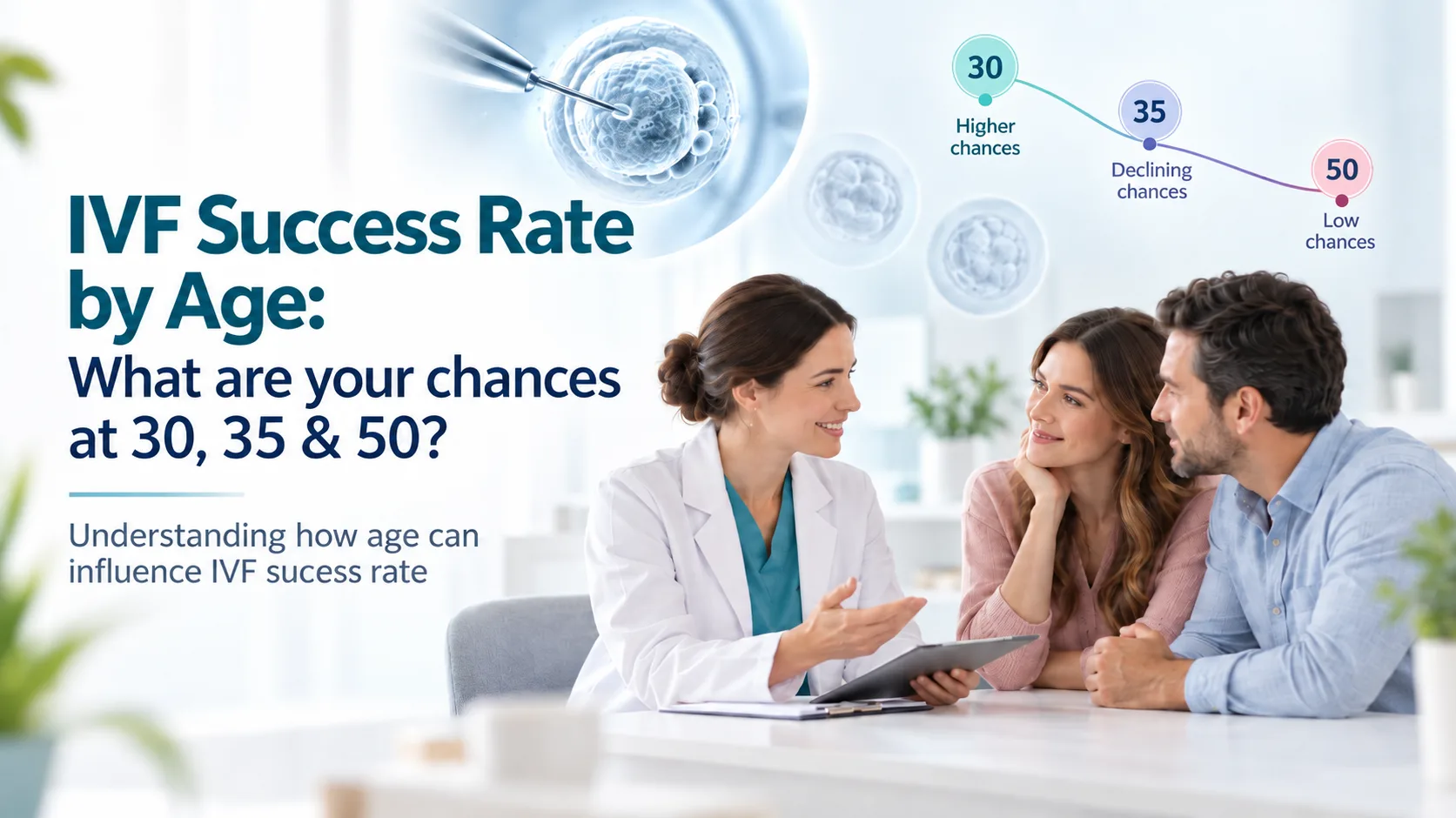
Modern laboratories, stimulation protocols, and genetic testing have significantly improved final IVF outcomes. However, they cannot fully overcome the natural decline in egg quality that happens with advancing age.
Age remains the single most vital factor influencing IVF success rates. Hence, it is essential to understand the IVF success rate by age.
This helps couples:
- Set realistic expectations;
- Decide when to begin treatment; and
- Evaluate options such as multiple cycles or donor eggs.
In IVF, Why Does Age Matter So Much?
A woman is born with all the eggs she will ever have. Over time, both the number and genetic quality of these eggs decline.
The proportion of eggs with chromosomal abnormalities (aneuploidy) rises sharply after the mid-30s. An embryo with the wrong number of chromosomes is less likely to implant and is more likely to result in miscarriage.
This explains why fertility after 35 changes noticeably and why the IVF success rate after 35 and IVF success rate after 40 are lower than in younger women, even when the same high-quality laboratory techniques are used.
AMH (Anti-Müllerian Hormone) reflects the remaining egg supply, or quantity, but does not measure egg quality. A high AMH at age 40 is encouraging for the number of eggs that may be retrieved, yet the chance that those eggs are chromosomally normal remains age-dependent.
IVF Success Rate at Age 30
Most women around age 30 still maintain good egg quantity and quality.
Live-birth rates per IVF cycle using a woman's own eggs commonly fall in the 40–55% range in well-performing clinics. Some centres report even higher figures for carefully selected patients under age 32–33.
Major points at this age include:
- A higher average number of eggs retrieved;
- Better fertilization and blastocyst development rates;
- Lower aneuploidy rates; and
- Stronger cumulative success across two or three cycles, often around 70–85%.
The IVF success rate on the first attempt is already favourable for many couples at age 30.
If the first cycle does not succeed, remaining frozen embryos or a second retrieval may still offer excellent cumulative odds. When there are known fertility issues, specialists encourage earlier evaluation rather than waiting until the late 30s.
IVF Success Rate at Age 35
Age 35 is often considered the start of a steeper decline.
The IVF success rate after 35 typically ranges from 25–40% live births per cycle using a woman's own eggs. The exact rate depends on the age band—35–37 versus closer to 38—and individual factors.
What Changes Around 35?
- A gradual reduction in the number of eggs retrieved;
- A rising percentage of chromosomally abnormal embryos;
- A slightly higher miscarriage risk, even after a positive pregnancy test; and
- Greater value from strategies such as blastocyst culture and, in selected cases, PGT-A (preimplantation genetic testing for aneuploidy).
Fertility after 35 remains good for many women, especially those with normal AMH and no additional complications. However, time becomes more important.
Delaying treatment by two or three years can shift a patient from the more favourable 35–37 bracket into the lower-success 38–40 bracket. Cumulative live-birth rates over two to three cycles remain meaningful, often around 55–75% for women beginning treatment at ages 35–37 in good centres.
IVF Success Rate at Age 50
By age 50, the overall picture with a woman's own eggs changes dramatically. Live-birth rates per cycle typically fall to 1–5% or even lower. At this stage, very few eggs may be retrieved, the vast majority carry chromosomal abnormalities, and miscarriage risk is substantially higher.
Most clinics discuss donor-egg IVF as the primary option at this age. With donor eggs, usually from women in their 20s, success rates may rise to approximately 50–65% per transfer and are largely independent of the recipient's age. However, outcomes also depend on the health of the recipient's uterus. Uterine receptivity remains adequate for most women well into their mid-40s and, in selected cases, beyond.
The IVF success rate by age at 50 is therefore low with autologous eggs, but it can be comparable to that of younger patients when donor eggs are used.
Broader Age Bands and What the Numbers Mean
Based on international registries and Indian clinical data, the approximate live-birth rates per cycle using a woman's own eggs are:
- Under 30: 40–55% or higher;
- 30–34: 35–50%;
- 35–37: 25–40%;
- 38–40: 15–30%;
- 41–42: 8–18%;
- 43–44: 3–10%; and
- 45 and above: usually under 5%.
These are population averages. Individual outcomes vary according to:
- AMH;
- Sperm quality;
- Uterine factors;
- Laboratory standards; and
- Whether PGT-A is used.
Clinic-reported rates in Hyderabad and other Indian cities can sometimes appear higher because they may quote clinical pregnancy rates rather than live-birth rates or select patients with more favourable profiles. Always ask for age-stratified live-birth data.
IVF Success Rate in Hyderabad
The IVF success rate in Hyderabad follows the same age-related pattern seen nationally and internationally.
Leading IVF centres in Hyderabad report competitive outcomes, especially for women under 35–37. As elsewhere, results decline with age.
When comparing clinics, ask for:
- Live-birth rates by age group, not just pregnancy rates;
- The number of cycles performed in each age band;
- Cumulative success over multiple cycles; and
- The clinic's policy on single-embryo transfer and PGT-A.
Transparent reporting and age-specific data are more useful than a single overall success percentage.
First-Attempt Success vs. Cumulative Success
The IVF success rate on the first attempt is important, but it is only part of the overall story.
Many patients achieve pregnancy on the second or third cycle, especially when surplus embryos have been frozen. Cumulative live-birth rates after two or three complete cycles are substantially higher than single-cycle figures for women under age 40.
This is why financial and emotional planning should account for the possibility of more than one cycle.
Role of AMH and Other Factors
AMH helps:
- Predict how many eggs may be retrieved; and
- Guide ovarian stimulation planning.
A low AMH suggests a poorer response and fewer embryos, which can reduce cumulative chances. However, a normal or high AMH in a woman in her late 30s or 40s does not guarantee high egg quality. Age remains the dominant factor affecting aneuploidy risk.
Other major influencing factors include:
- Sperm DNA quality and male age;
- The uterine environment and endometrial receptivity;
- Lifestyle factors such as smoking, weight, and metabolic health;
- Laboratory expertise and culture conditions; and
- The appropriate use of advanced techniques.
The Need for Realistic Expectations
Statistics describe groups, not individuals. Some women achieve success at age 38 on the first cycle, while some younger women require several attempts.
To understand these differences, a fertility specialist can refine the outlook for your specific situation using:
- AMH;
- Antral follicle count;
- Semen analysis; and
- Uterine evaluation.
Select a clinic that offers:
- Strong laboratory standards;
- Transparent, age-stratified data; and
- Supportive counselling.
These qualities can improve the overall treatment experience and outcome.
Final Word
Egg quality diminishes over time, leading to a progressive decline in the IVF success rate by age.
Chances are:
- Highest at age 30;
- Good, but beginning to decline, at age 35; and
- Rare with a woman's own eggs at age 50, when donor eggs become the more realistic path.
The IVF success rate after 35 and IVF success rate after 40 reflect this biological reality. Cumulative rates across multiple cycles provide a more complete picture than any single attempt.
AMH offers useful information about egg supply, but age remains the strongest predictor of outcome. Clinics in Hyderabad and across India follow the same age-related patterns seen worldwide.
Couples are best positioned to navigate treatment with clarity and realistic hope when they:
- Understand these numbers;
- Seek personalised advice early; and
- Plan for the possibility of more than one cycle.
FAQs
What is the IVF success rate by age, and why does it decline?
The IVF success rate by age drops because egg quality and chromosomal normality decline over time. Younger eggs are more likely to create healthy embryos that implant and lead to a live birth. This is why success is highest in the early 30s and steadily reduces thereafter, even with advanced laboratory techniques.
What is the typical IVF success rate at age 30?
The IVF success rate around age 30 using a woman's own eggs generally ranges from 40–55% live births per cycle in good clinics. Egg quantity and quality are still favourable, so the IVF success rate on the first attempt is often strong. Cumulative chances can be excellent over two or three cycles.
How does the IVF success rate change after age 35?
The IVF success rate after 35 typically falls to approximately 25–40% live births per cycle. Rates are higher at ages 35–37 and lower closer to ages 38–40. Fertility after 35 remains viable for many women, but the rise in chromosomally abnormal eggs makes timely treatment more important.
What is the IVF success rate after 40 and at age 50?
The IVF success rate after 40 reduces further, often to 8–18% at ages 41–42 and under 5–10% after age 43 when using a woman's own eggs. At age 50, success with autologous eggs is very low, usually 1–5% or less. Donor-egg IVF, however, may offer success rates of approximately 50–65%, largely independent of the recipient's age.
Does AMH predict IVF success better than age?
AMH indicates the remaining egg supply and helps predict how many eggs may be retrieved. It does not measure egg quality. Age remains the strongest predictor of chromosomal normality and overall IVF success rate. A high AMH at an older age is helpful for egg numbers but does not eliminate the age-related decline in quality.
What is the IVF success rate on the first attempt?
The IVF success rate on the first attempt varies widely by age. It is often 40% or higher under age 35, lower after 35, and significantly reduced after age 40. Many patients succeed on the second or third cycle, especially when frozen embryos are available. Cumulative success over multiple cycles is therefore more meaningful than any single attempt.
How does the IVF success rate in Hyderabad compare by age?
The IVF success rate in Hyderabad follows the same age-related pattern seen nationally and globally. Top clinics report competitive outcomes, especially for women under 35–37. Patients should request age-stratified live-birth rates rather than overall averages because results differ significantly between younger and older age groups.